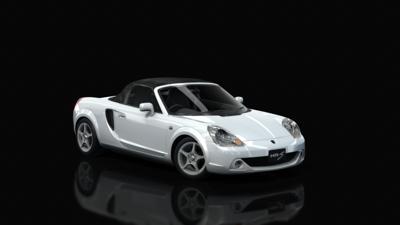
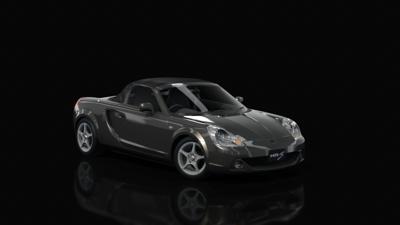
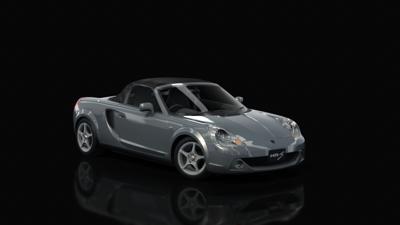
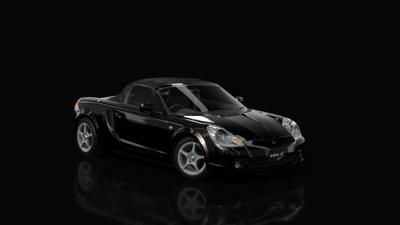
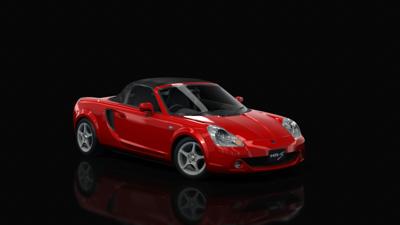
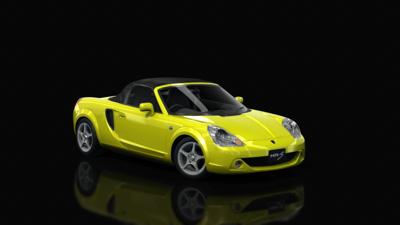
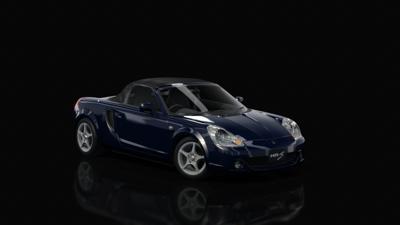
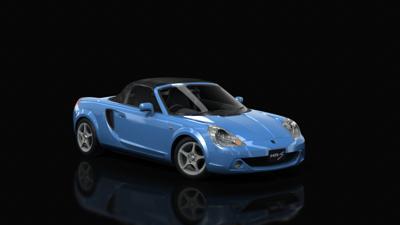
The third-generation MR2 was marketed as the Toyota MR-S in Japan, Toyota MR2 Spyder in the US, and the Toyota MR2 Roadster in Europe, except for France and Belgium, where it was marketed as the Toyota MR Roadster.[3]
Also known as the Midship Runabout-Sports, the newest MR2 took a different approach than its predecessor, most obviously becoming a convertible and receiving the 'Spyder' marketing nomenclature.
Spyder exterior
The first prototype of MR-S appeared in 1997 at the Tokyo Motor Show. The MR2 Spyder chief engineer Harunori Shiratori said, "First, we wanted true driver enjoyment, blending good movement, low inertia, and lightweight. Then, a long wheelbase to achieve high stability and fresh new styling; a mid-engine design to create excellent handling and steering without the weight of the engine upfront; a body structure as simple as possible to allow for easy customizing, and low cost to the consumer."[29]
The only engine available for the ZZW30 was the all-aluminum alloy 1ZZ-FED, a 1.8 L (1,794 cc) inline-four engine. Like its predecessors, it used DOHC and 4 valves per cylinder. The intake camshaft timing was adjustable via the VVT-i system, which was introduced earlier on the 1998 MR2 in some markets. Unlike its predecessors, however, the engine was placed onto the car the other way round, with the exhaust manifold towards the rear of the car instead of towards the front. The maximum power of 138 bhp (140 PS; 103 kW) at 6,400 rpm and 126 lb⋅ft (171 N⋅m) of torque at 4,400 rpm[48] was quite a drop from the previous generation, but thanks to the lightness of the car it could still move quite quickly, accelerating from 0 to 100 km/h (62 mph) in 6.8 to 8.7 seconds depending on the transmission option,[49][50] the SMT being unable to launch and shift as quickly as the conventional manual transmission.[51] Curb weight is 996 kg (2,195 lb) for manual transmission models.
In addition to the 5-speed manual transmission, a 6-speed manual and 5-speed SMT were made available starting in 2002. A form of automated manual transmission, the SMT has no conventional H-pattern shift lever nor clutch pedal. The driver shifts gears by tapping the shift lever forward or backward or by pressing steering-wheel-mounted buttons. Clutch engagement is automated, and the system modulates the throttle on downshifts, matching engine speed to transmission speed seamlessly. The system prioritizes clutch life over shift speed, hence shifts and launches are slower and gentler than those a human driver can perform using a conventional manual transmission, hindering rapid acceleration somewhat. Unlike similar systems offered in contemporary sports cars, the SMT lacks a fully automated mode emulating an automatic transmission.[51] The SMT automatically shifts to second and then first gear when stopping. The SMT was a standard feature in the Australian market; however, air conditioning was optional. After 2003, a 6-speed SMT was an option. Cruise control was never offered with the manual transmission but was standard for SMT-equipped cars. Some collectors prefer the SMT over the standard 5-speed manual transmission because in top gear the SMT spins at 2,780 rpm instead of 3,000 rpm for the 5-speed manual at 97 km/h (60 mph) – making it slightly quieter and giving better economy, even with the extra weight. The drawback to the SMT is slower acceleration and very few technicians actually understand the more complex system.[citation needed]
The MR2 Spyder featured a heated glass rear window. A hardtop was also available from Toyota in Japan and Europe.
Yearly changes
October 1999 (MY 2000)
The MR-S was introduced in October 1999 to the Japanese market in three trim levels: the "B", the "Standard", and the "S". The "S" trim level included power windows, locks, mirrors, AM/FM/CD radio, cloth seats, tilt steering wheel, and alloy wheels.
In March 2000, the car was introduced into the United States and Europe as a "monospec" level, which included the same features as Japan's "S" trim level. In October 2000 the car was introduced in Australia[52] as a 5-speed SMT only.
2001 (MY 2002)
5-speed SMT introduced in the US.
2002 (MY 2003)
New paint colors
New front and rear fascias, standard fog lights, power antennae, and color-matched side air intakes
16-inch rear wheels with larger tires
New seats, slight changes to the gauge cluster and interior
SMT now has six forward gears and faster shifting
New springs, dampers, and a new underbody brace
2003 (MY 2004)
Torsen (helical) limited-slip differential available as an option (C65-01B transmission)
Strengthened unibody for crash intrusion protection (resulting in 10 kg (22 lb) greater curb weight)[29]
Ride height increased approximately 1 inch in all markets
2004 (MY 2005)
6-disc in-dash CD player standard
Last year of sales in North America
2006 (MY 2007)
Last year of sales
Special "V-Edition" and "TF300" editions sold only in the United Kingdom.
Some of Final Edition have Burgundy soft top.
Performance and handling
MR2 Roadsters (EU)
The feedback for the new model was somewhat mixed. Some liked its new design concept, while fans of the SW20 would've liked it to continue along the path of the previous model. All agreed, however, that the ZZW30 had nearly perfect handling. The ZZW30 is considered to be the best-handling MR2 in both overall limit and controllability. For example, Tiff Needell, a very experienced race driver and the former host of the BBC television series Top Gear, praised the handling of the ZZW30.[53] Although some complained of the relative lack of power, many owners have opted to switch out the 1ZZ-FE engine in exchange for the 141 kW; 189 bhp; 192 PS 2ZZ-GE.


