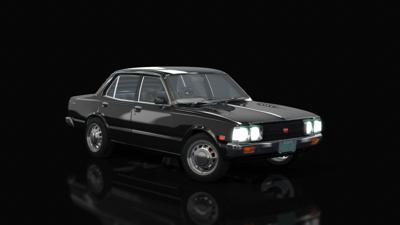
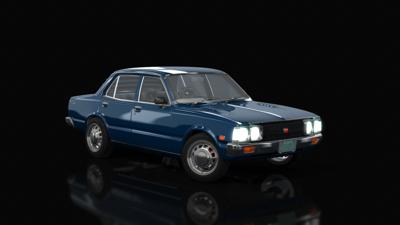
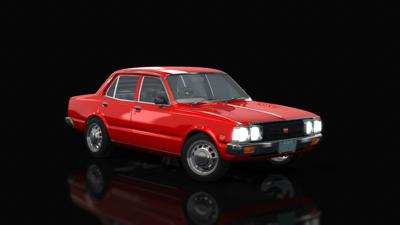
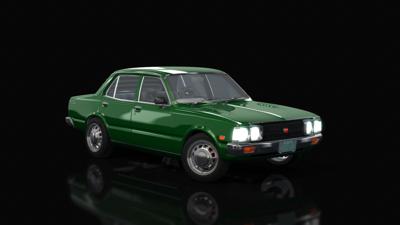
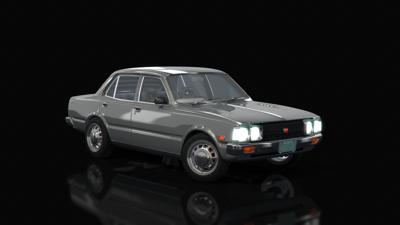
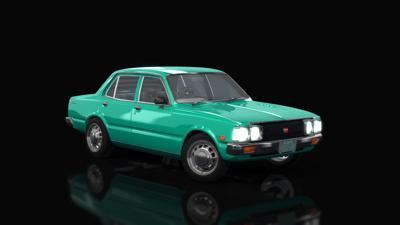
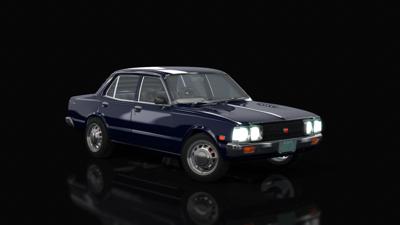
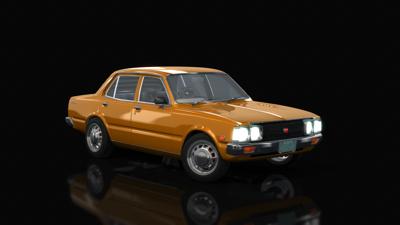
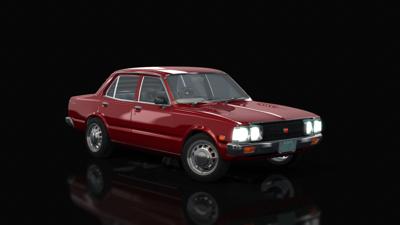
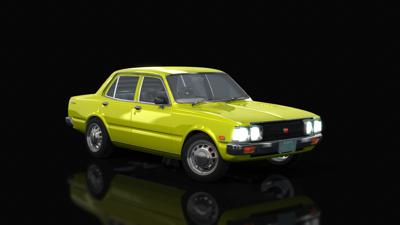
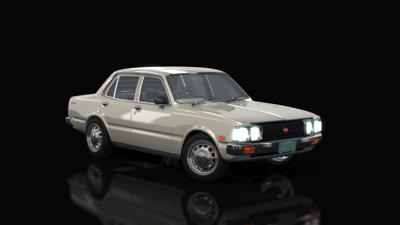
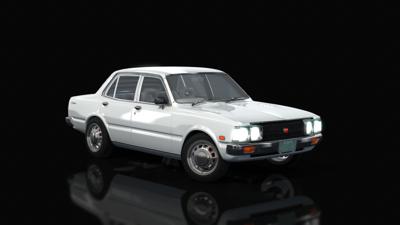
v1.2 by Toby Juggs
3D model corrections - shader updates - 70s driver added & repositioned - shifting animation added - skins added - LODs added - lights edited.
Required: rain glass, working wipers
MODEL 3D BASE : Quartermaster
INTERIOR : Honda Prelude Mr X (+ texture) - adjustment SGM
-------------------------------------------------------------------------------------------------------
IMPORT / CONVERSION / INTERIOR... : Saru (SGM) 族
Physique + Analogue instrument... : Knut (SGM) 族
-------------------------------------------------------------------------------------------------------
- You are free to do what you want with it, but don't forget to credit "Saru Graphic - SGM"
-------------------------------------------------------------------------------------------------------
Wikipedia:
31 August 1973 saw the introduction of the Corona T100-Series, which continued to be built as a two-door or four-door sedans, a two-door hardtop coupé (T110 chassis codes) and as a four-door station wagon (marketed as a van for commercial use in Japan). Chassis codes 100–105 were reserved for sedans, with 106–109 for vans, the 110–115 was for the hardtop coupé while 116–119 was for the wagon versions. The 120-series model codes were used for late series face lifted models in the Japanese market fitted with the new emissions control TTC-C motors. The two-speed automatic was no longer offered. The face lift revised the hood and grille, and enlarged the tail lights. The station wagon featured optional wood panel body claddings. Engines were 1.6, 1.8 and 2.0-litre SOHC units. In North America, the 20R 2.2-litre engine was used.
The high-performance 2000GT Sedan and Hardtop Coupé with 18R-G twin cam engine were only offered in Japan. Yamaha supplied the alloy head for these high performance normally aspirated engines fitted with twin Mikuni-Solex 40 mm side-draft carburettors and a compression ratio of 9.7:1. Gearbox was the Porsche-type syncromesh 5-speed P51 coupled to a 4.1 F series limited slip differential, giving a claimed top speed of 200 km/h (125 mph). In 1972, a new set of performance coupes is introduced on the Corolla platform called the Corolla Levin and Sprinter Trueno.
1976 Corona sedan (RT102, Japan)
North American models had longer bumpers (hiding recoverable bumper shocks) to meet local 5 mph (8.0 km/h) impact standards; they gained standard radial tires in 1975. Side door impact upgrades were installed in all doors. This series also saw the standard (on some models) Electro Sensor Panel which monitored fluid and bulb status. As with earlier Coronas, some models had a shifter mounted on the steering column. Sales of the Corona continued to grow as a result of the 1973 oil crisis. The two-door hardtop continued, with trim levels 1600GL, 1800SR and the 2000SR, with the coupé proving popular in the US but more popular yet in Japan. The two-door sedan, meanwhile, sold well in the United States but very little in Japan, and this was the last Corona to be offered in this bodystyle.
The Corona saw new competitors in both Japan, Europe and the United States from the Honda Accord in 1976, and the Subaru DL in 1974. The advantage the Honda and Subaru had over the Corona was that both vehicles were front-wheel-drive, while the Corona was rear-wheel-drive. In response to the Japanese Governments passage of emission control regulations, Toyota introduced the Toyota TTC-V (Vortex) on the 80 PS (59 kW) 19R engine only, using an Exhaust gas recirculation implementation. In Japan, the 12R-U engine was designed to run on LPG for taxi usage, starting in October 1975. To meet new emissions regulations the 1.6-litre 12R engine was replaced by the more modern 2T-J in commercial models. The 18R-E engine with fuel injection that was used in the 2000SL and 2000SR discontinued production due to emission issues. In November 1975, the 1800 saw the removal of the twin carburetors due to emission regulations, which meant the discontinuation of the 1800SR coupé. June 1976 saw the installation of a catalyst system included with the TTC-C system.
January 1977 saw a minor appearance change to both the interior and exterior, with a revised grille and hood, as well as new headlight surrounds. The taillights were also modified; while still rectangular, they were less busy in appearance.[35]
New Zealand assembly began with 1.6 OHV, three-speed manual column shift and bench front seat and 1.8-litre 16R OHC four-speed manual bucket front seat options. Later, the 18R 2.0-litre OHC engine replaced the 1.8 and was also offered with a three-speed automatic, the first auto Corona in New Zealand. Australian models had the 18R from the start, as did South African ones.


