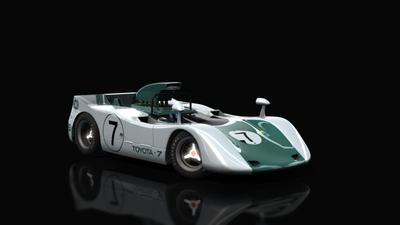
v1.0.1 by ACTK
Fix flames.ini
Add LODs
Add data to data.acd
Development on the new Toyota 7 began in May 1968 immediately following the Japan Grand Prix.The new Toyota 7 was referred to internally as the 474S, while press material referred to it as the New 7.[3] The first 474S chassis was completed in March 1968, and began testing with a 5.8 litre Chevrolet small block V8 engine installed.
The aluminium monocoque chassis was discarded in favour of a steel pipe space frame chassis, similar to the Nissan R381. The bodywork was completely redesigned, initially as a closed-cockpit body. But due to problems with visibility and weight, Toyota discarded the closed-cockpit 474S in favour of a new open-cockpit body, shaped similar to a large broad wedge for increased front downforce. At the rear of the car, the exhaust pipes were placed within the bodywork, while an intake scoop was mounted over the rollbar. Daihatsu Motor Corporation were now involved with the project, having lent their wind tunnel to Toyota and Yamaha to develop the redesigned open-cockpit body.
Toyota's new five-litre V8 engine, the 79E, was completed and installed on 23 April. The 79E's design was derived from the Ford Cosworth DFV, and was capable of producing 395 kW (530 hp; 537 PS) at 7,600 rpm, and 519.75 Nm of torque at 5,600 rpm. This now meant that they had a powerplant that could match the Nissan GRX-I V12 engine, which was still in development.
The closed-cockpit 474S took its first victory in the 1969 Suzuka 500 km on 6 April, as Minoru Kawai took his first victory with Team Toyota. Two months after the open-cockpit body was completed, the revised 474S made its debut at the Fuji 1000 km, where the team of Fushida and Otsubo claimed Toyota's third consecutive victory in the event. On 10 August, Fushida won the NET Speed Cup Race at Fuji.
1969 Japan Grand Prix
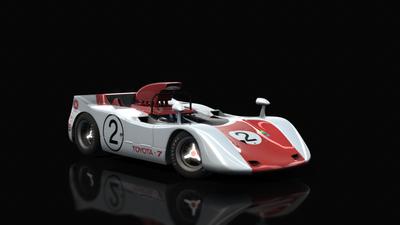
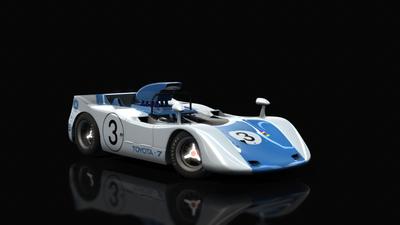
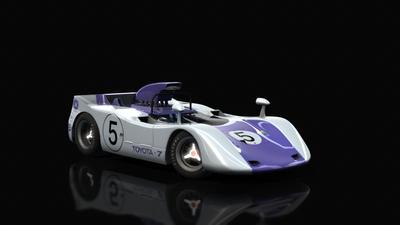
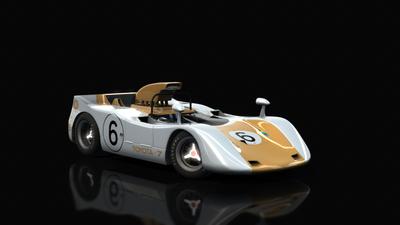
The New Toyota 7's main event for the year was the 1969 Japanese Grand Prix [ja], held on 10 October. Toyota entered five 474S for the event, and because the race distance was extended to 720 km, teams could now register two drivers to a car. Kawai drove alone in the number 3 Toyota with the light blue stripe. Former Daihatsu works driver Hiroyuki Kukidome joined Hosoya in car #2 (red), Fushida was partnered by newcomer Harukuni Takahashi in car #5 (dark blue), Kanie was partnered by Kiyoshi Misaki in the #6 (yellow), and Vic Elford was recruited to drive the #7 (green) entry, joined by Toshiaki Takahashi. Nissan arrived with their revised R382s, which now had the new six-litre GRX-III V12 engine, and Taki Racing Organisation partnered with Porsche to field the new 917 and 908.
Kawai, who qualified fifth for the race, led the first two laps of the race, and eventually finished in third, just one lap behind the R382s of race winner Motoharu Kurosawa and runner-up Moto Kitano. Elford finished fourth, while the Kukidome/Hosoya car finished fifth. Meanwhile, tyre problems left the Kanie/Misaki car in 13th (26 laps down), and Fushida spun off and retired after a suspension failure on Lap 5. Although Toyota was able to outperform the new Porsche 917 from Taki Racing, the Nissans once again proved too daunting, thanks to their late introduction of the GRX-III engine.[8]
1969 World Challenge Cup Fuji 200 Mile Race
The Toyota 7 had taken many endurance racing victories and had won many domestic sprint races, but hadn't won the Japan Grand Prix or the "Japan Can-Am", regarded as the two biggest races on the calendar at the time. That changed on 23 November 1969, at the second running of the World Challenge Cup Fuji 200 Mile invitational race. For this race, the 474S was modified with the addition of a rear spoiler, which had been banned from use in the Japan Grand Prix.
Minoru Kawai, driving the white and blue number 8 Toyota 474S, won the race ahead of John Cannon's Ford G7A,[9] a milestone for the Toyota 7 project. Two other Toyota 474S were entered, however, Kukidome (#6) retired after 46 laps, and Hosoya (#7) retired after 35 laps. In addition, a modified McLaren M12 with the Toyota 79E engine was entered as a research and development car for Fushida, who retired after 21 laps.
Twelve 474S chassis were constructed, and the only survivor is Kawai's Japan Can-Am winning car, which was restored in 2007.


