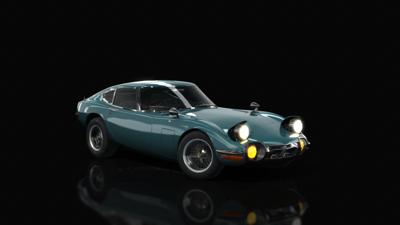
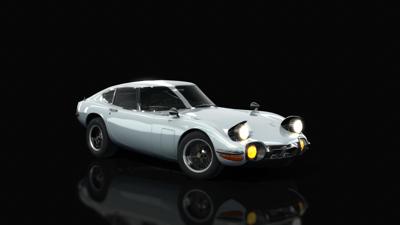
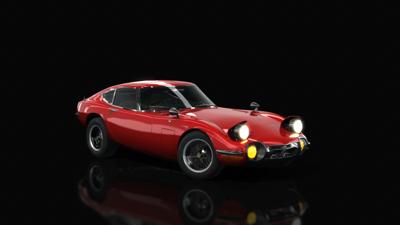
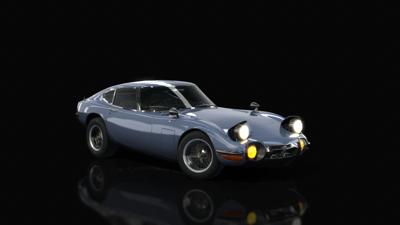
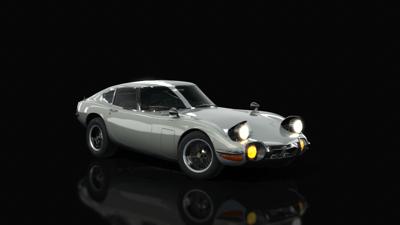
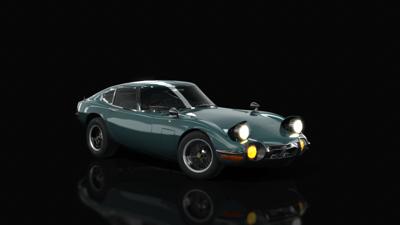
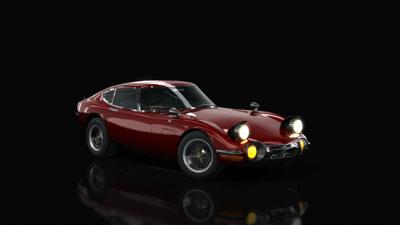
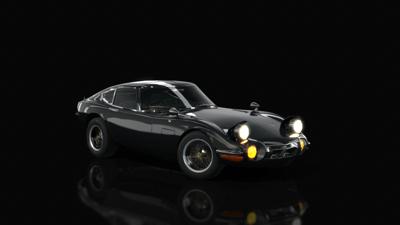
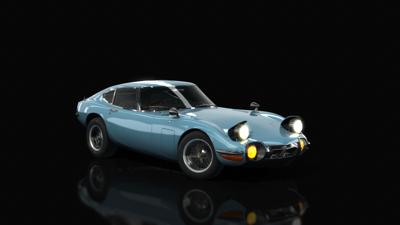
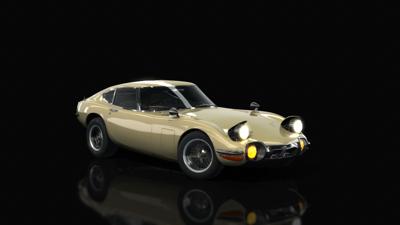
v1.1 by ACTK
Fix tyres.ini
Fix windows
Add COCKPIT_HR in 3d model
Add LODs
Add main_geometry.vao-patch
Toyota 2000GT is a rear-wheel-drive two-seater sports coupe manufactured by Toyota in a limited series in the 1960s. The car went down in history as the first Japanese supercar.
The sixties were the heyday of the entire Japanese auto industry, including Toyota. The company, founded by businessman Kiichiro Toyoda in the 1930s, had already gained sufficient fame and authority by the middle of the century - at that moment the legendary Crown, Corolla and Land Cruiser had already appeared in its lineup - and in 1962 marked the day of the millionth car production. However, in the western market Toyota was perceived as a manufacturer of purely utilitarian models: family subcompacts and SUVs - practical, reliable, but by no means status. Such a reputation ceased to suit an ambitious Japanese company, and in the mid-1960s its management decided to enter the international market with a flagship sports car that could compete with the most prestigious European brands. This decision was consolidated thanks to the rather unexpected success of the first sports car of the company - the compact Sports 800 coupe, which, having only a two-cylinder 45-horsepower engine, won first place in the GT-1 class at the Japanese Automobile Club in 1963.
The first prototype, called Project 280A, was created by 1965 under the leadership of Jiro Cavanaugh. However, Toyota, feeling the lack of its own experience in the production of sports cars, decided to involve Yamaha in the development. The latter proposed the A550X project that already existed in her - a prototype of a sports car, which was originally created for Nissan, but did not receive support (it is believed that Yamaha president Geniti Kawakami himself was looking for a meeting with Kavano in order to achieve his work). This time the project was fully approved, and as a result, the two companies joined forces using the Yamaha A550X technical developments and the Toyota 280A design developed by Satoru Nozaki. Since the car retained the same engine capacity, the name of the Nissan 2000GT prototype also passed to it, under which the serial Toyota subsequently came out.
Toyota management realized that entering the European market, it challenges rivals with much more serious experience and potential. Therefore, when developing a car to compensate for its backlog, the company purchased a number of the best models of European competitors - Lotus Elan, Triumph TR2, Porsche 911 and Jaguar E-Type. The machines were tested, disassembled and carefully studied, and not only successful solutions, but also disadvantages were examined: it was necessary to understand how not to repeat the mistakes of others.
The result of these efforts was the chassis, created at the level of world-class sports cars: it was distinguished by technical perfection even by European standards, and for the Japanese industry it was a real breakthrough. The 2000GT design found application in the most advanced technologies of those years, most of which were used in Japan for the first time: a Lotus spinal frame, a fully independent suspension like the Jaguar E-Type, disc brakes, a differential with a lock, etc. At the same time, Toyota set a goal to create its own concept of gran turismo: for all the road qualities required by a sports car, it was obliged to have a maximum of comfort and luxury, as opposed to the asceticism of traditional sports cars.
Making an exceptionally complex body manually from steel sheets completely contradicted the approaches of Toyota, whose plants were already overloaded with the release of standard models. So the entire production was entrusted to Yamaha, who performed contract work for Toyota as a contractor.
The presentation of the Toyota 2000GT first took place at the 1965 Tokyo Auto Show. The car aroused universal admiration: although it was not the fastest in its class (the Jaguar XKE and Porsche 911 were noticeably more dynamic), it surpassed them in comfort and excellent handling, including excellent stability at maximum speed. The car turned out to be miniature (with a length of 4175 mm, the height was only 1160 mm) and the two-seater saloon was quite cramped by European standards; but at the same time it is generously equipped and finely finished, with a wooden instrument panel (the Yamaha division producing pianos was responsible for the manufacture) and a standard radio with automatic station search. The style was deliberately made conservative, to contrast with the ultra-modern appearance.
The engines of the production car had the inscription “Toyota 2000”, but in reality it was also the work of Yamaha - the inline six-cylinder engine under the 3M index had a volume of 2.0 liters (the engine of the M series from Toyota Crown was the basis), was equipped with hemispherical combustion chambers, two camshafts and three two-chamber Mikuni-Solex carburetors, and gave out power of 150 hp Since, as befits a purebred sports car, the Toyota 2000GT was distinguished by a modest weight of 1120 kg and an almost perfect weight distribution, this made it possible to achieve good dynamic characteristics and handling. According to the tests of the American magazine Road & Track in June 1967, the car accelerated to 100 km / h in 10.0 seconds, had a top speed of over 215 km / h and covered a distance of 1/4 mile in 16.6 seconds.
An important factor that was supposed to consolidate the success of the model were victories in sports. However, the situation here was not as favorable as Toyota had originally hoped for: specially prepared 2000GT racers easily began to dominate the competitions at home, but abroad, in the races of the 1968 Pacific Sports Car Club of America division, the 2000GT could not rise above 2 places, losing to Porsche gold.
The second reason the company decided to curtail production of its first supercar was the fact that the 2000GT model, despite all the efforts made by Toyota, did not become competitive in the most desirable market for Japan - the American one. Instead of the expected demand at the level of 500 units annually, only 58 cars were delivered across the ocean in 1967-70, ten times less than the Porsche and Jaguar sports cars.
From September 1966 to October 1970, 351 Toyota 2000GTs of all specifications were produced, including pre-production units. 115 copies went to the world market (of which more than half are in the USA), the rest are sold in Japan. Despite the high retail price ($ 6,800 - at the Porsche 911 level and 15% more expensive than the Jaguar E-Type), from a commercial point of view, the project did not pay off: on the contrary, the Japanese concern actually lost money on each machine. But in return, Toyota acquired something more important: the long-awaited image of the manufacturer of modern, technological and fast cars.
One of the symbols of this success was the participation of Toyota 2000GT in Hollywood filming: the car fell into the frames of the next James Bond film, “You Only Live Twice” (1967). However, it was not possible to use the serial model for this purpose - the actor Sean Connery did not physically fit in a cramped salon, so the company had to rush to make two copies in a roadster body (this type of body did not go into mass production).
Toyota 2000GT went down in history as the first Japanese supercar, paving the way for Japanese car industry icons like Toyota Celica (which appeared in 1970 as an inexpensive replacement for the 2000GT) and Toyota Supra. Today, the surviving Toyota 2000GTs are considered the most coveted and valuable Japanese cars in the world, and a copy sold in 2013 by RM Auctions for $ 1.2 million set a record auction price for an Asian car.
============================================================================
Toyota 2000GT — заднеприводное двухместное спортивное купе, выпускавшееся Toyota ограниченной серией в 1960-х годах. Автомобиль вошёл в историю как первый японский суперкар.
Шестидесятые годы стали эпохой расцвета всей японской автоиндустрии, в том числе и Toyota. Компания, основанная бизнесменом Киитиро Тойода в 1930-х годах, к середине века уже приобрела достаточную известность и авторитет — в этот момент в её модельном ряду уже появились легендарные впоследствии Crown, Corolla и Land Cruiser — а 1962 году отметила день выпуска миллионного автомобиля. Однако на западном рынке Toyota воспринималась как производитель чисто утилитарных моделей: семейных малолитражек и внедорожников — практичных, надёжных, но отнюдь не статусных. Такая репутация перестала устраивать амбициозную японскую фирму, и в середине 1960-х её руководство пришло к решению выйти на международный рынок с флагманским спорткаром, способным составить конкуренцию самым престижным европейским маркам. Это решение закрепилось благодаря довольно неожиданному успеху первого спортивного автомобиля фирмы — компактного купе Sports 800, которое, обладая всего лишь двухцилиндровым 45-сильным моторчиком, заняло первое место в классе GT-1 на гонках Японского автомобильного клуба в 1963 году.
Первый прототип под названием «проект 280A» был создан к 1965 году под руководством Джиро Кавано. Однако в Toyota, чувствуя нехватку собственного опыта в производстве спортивных машин, решили привлечь к разработке компанию Yamaha. Последняя предложила уже существовавший у неё проект A550X — прототип спортивной машины, который изначально создавался для Nissan, но поддержки не получил (есть мнение, что президент Yamaha Генити Каваками сам искал встречи с Кавано, чтобы добиться реализации своей работы). На этот раз проект был полностью одобрен, и в итоге две компании объединили усилия, используя технические наработки Yamaha A550X и дизайн Toyota 280A, разработанный Сатору Нозаки. Поскольку машина сохранила тот же объём двигателя, к ней перешло и название прототипа Nissan — 2000GT, под которым впоследствии и вышла серийная Toyota.
Руководство Toyota осознавало, что выходя на европейский рынок, она бросает вызов соперникам с куда более серьёзным опытом и потенциалом. Поэтому при разработке автомобиля, чтобы компенсировать своё отставание, фирма закупила ряд лучших моделей европейских конкурентов — Lotus Elan, Triumph TR2, Porsche 911 и Jaguar E-Type. Машины протестировали, разобрали и тщательно изучили, причём исследованию подвергались не только удачные решения, но и недостатки: требовалось понять, как не повторить чужие ошибки.
Результатом этих усилий стало шасси, созданное на уровне спортивных автомобилей мирового класса: оно отличалось техническим совершенством даже по европейским меркам, а для японской промышленности было настоящим прорывом. В конструкции 2000GT нашли применение самые передовые технологии тех лет, причём большинство из них использовались в Японии впервые: хребтовая рама в стиле Lotus, полностью независимая подвеска как на Jaguar E-Type, дисковые тормоза, дифференциал с блокировкой и т.д. При этом в Toyota поставили цель создать собственную концепцию gran turismo: при всех дорожных качествах, необходимых спортивному автомобилю, он обязан был иметь максимум комфорта и роскоши, в противовес аскетичности традиционных спорткаров.
Изготовление исключительно сложного кузова вручную из стальных листов полностью противоречило подходам Toyota, заводы которой и без того были перегружены выпуском стандартных моделей. Так что всё производство поручили Yamaha, выполнявшим контрактную работу для Toyota в качестве подрядчика.
Презентация Toyota 2000GT впервые состоялась на Токийском автошоу 1965 года. Автомобиль вызвал всеобщее восхищение: хотя он и не был самым быстрым в своём классе (Jaguar XKE и Porsche 911 были заметно динамичнее), зато превосходил их комфортом и отличной управляемостью, включая великолепную стабильность на максимальной скорости. Автомобиль получился миниатюрным (при длине 4175 мм высота составляла всего 1160 мм) и двухместный салон был достаточно тесен по европейским меркам; но при этом щедро оснащён и превосходно отделан, с деревянной панелью приборов (за изготовление отвечало Nippon Gakki, подразделение Yamaha, производящее рояли) и штатным радио с автоматическим поиском станций. Стилистика осознанно была сделана консервативной, для контраста с ультрасовременным внешним видом.
На двигателях серийной машины стояла надпись «Toyota 2000», но в действительности это тоже была работа Yamaha — рядный шестицилиндровый мотор под индексом 3M имел объём 2,0 литра (в основу лёг двигатель серии М от Toyota Crown), был оснащён полусферическими камерами сгорания, двумя распредвалами и тремя двухкамерными карбюраторами Mikuni-Solex, и выдавал мощность 150 л.с. Поскольку, как и положено чистокровному спорткару, Toyota 2000GT отличалась скромным весом — 1120 кг и почти идеальной развесовкой, это позволило добиться хороших динамических характеристик и управляемости. Согласно тестам американского журнала Road & Track в июне 1967 года, машина разгонялась до 100 км/ч за 10,0 секунд, имела максимальную скорость свыше 215 км/ч и проходила дистанцию 1/4 мили за 16,6 секунд.
Важным фактором, который должен был закрепить успех модели, были победы в спортивных состязаниях. Однако здесь ситуация сложилась не так благоприятно, как на это изначально рассчитывали в Toyota: специально подготовленные гоночные 2000GT без труда стали доминировать в соревнованиях у себя на родине, но за рубежом, в гонках Тихоокеанского дивизиона Sports Car Club of America 1968 года 2000GT не смогли подняться выше 2 места, уступив золото Porsche.
Второй причиной, по которой в фирме решили свернуть производство своего первого суперкара, стал тот факт, что модель 2000GT, невзирая на все усилия, приложенные Toyota, так и не стала конкурентоспособной на самом желанном для Японии рынке — американском. Вместо ожидаемого спроса на уровне 500 экземпляров ежегодно, совокупно в 1967-70 годах за океан завезли только 58 машин — в десять раз меньше, чем спорткаров Porsche и Jaguar.
С сентября 1966 года по октябрь 1970 было произведено 351 Toyota 2000GT всех спецификаций, включая предсерийные экземпляры. 115 экземпляров ушло на мировой рынок (из них более — половины в США), остальные проданы в Японии. Несмотря на высокую розничную цену ($ 6800 — на уровне Porsche 911 и на 15% дороже Jaguar E-Type), с коммерческой точки зрения проект не окупил себя: напротив, японский концерн фактически терял деньги на каждой машине. Но взамен Toyota приобела нечто более важное: долгожданный имидж производителя современных, технологичных и быстрых машин.
Одним из символов этого успеха стало участие Toyota 2000GT в голливудских киносъёмках: автомобиль попал в кадры очередного фильма про Джеймса Бонда, «Живёшь только дважды» (You Only Live Twice, 1967). Впрочем, использовать для этой цели серийную модель не удалось — актёр Шон Коннери физически не помещался в тесный салон, так что фирме пришлось в спешном порядке изготовить два экземпляра в кузове родстер (в серийное производство подобный тип кузова не пошёл).
Toyota 2000GT вошла в историю как первый японский суперкар, проложив дорогу таким иконам японской автомобильной промышленности, как Toyota Celica (появившаяся в 1970 году в качестве недорогой замены 2000GT) и Toyota Supra. Сегодня сохранившиеся Toyota 2000GT считаются самыми желанными и ценными японскими автомобилями в мире, а экземпляр, проданный в 2013 году RM Auctions за $1,2 млн поставил рекорд аукционной цены на азиатский автомобиль.


