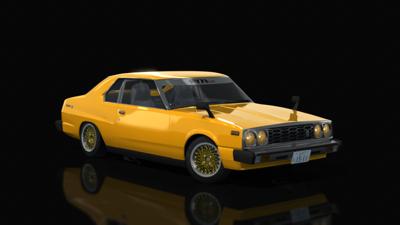
IMPORT / CONVERSION / INTERIOR... : Saru (SGM) 族
Physique + Analogue instrument... : Knut (SGM) 族
SGM WORKSHOP: https://discord.gg/KfrWsPjWG5
-------------------------------------------------------------------------------------------------------
- If you share this vehicle, please keep the original link (sharemod)
- You are free to do what you want with it, but don't forget to credit "Saru Graphic - SGM"
-------------------------------------------------------------------------------------------------------
Wikipedia:
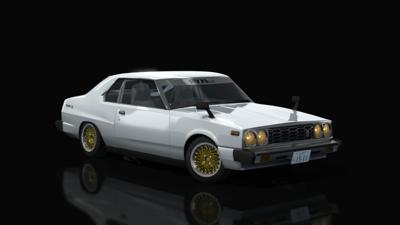
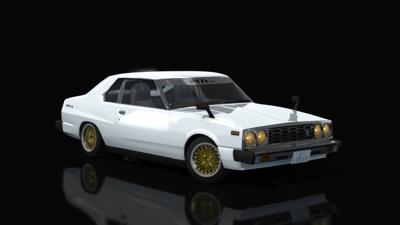
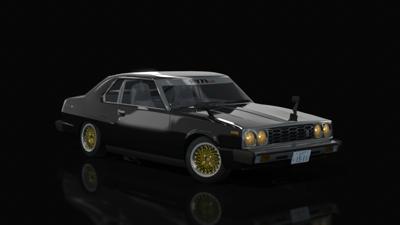
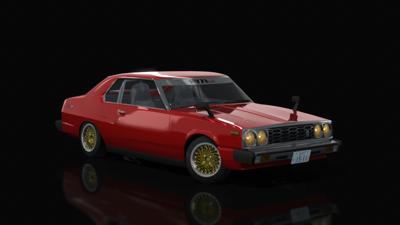
The succeeding C210 series of 1977 continued to split the Skyline range into basic four-cylinder and six-cylinder models, the latter with a longer wheelbase and front end. This line continued through 1981. A rare variant would be the wagon version, which had a unique styling treatment behind the rear doors, of a much smaller window than usual between the C and D pillars. The Skyline received an internal and external facelift in late 1978,which led to a change of the model code from 210 to 211. This was also when the Skyline first appeared in several European export markets, such as Germany.
The GT-EX replaced the discontinued GT-R with a turbocharged engine, the L20ET. As installed in the recently renewed Nissan Cedric/Gloria, this had been the first turbo engine to power a Japanese production vehicle.[36] One notable aspect of the turbo versions was that they were not intercooled and there was no form of blowoff valve, only an emergency pressure release valve. As usual with Japanese cars of this period, there were four- or five-speed manuals and a three-speed automatic, with a column-shifted three-speed manual available on lower end cars and vans.[34] The lowest powered option was the 2-liter LD20 diesel fitted to the Skyline Van 200D (VSC211D); it produces 65 PS (48 kW) at 4600 rpm.[33]
The "T" designation on the L16T and L18T does not signify a turbocharger was included; it denotes that those engines came with twin carburetors. The L-series engines were all switched to the cross-flow Z-series in late 1978, although the L16 soldiered on a little longer in the commercial versions. The larger 2.4 litre inline-six was never offered in the domestic Japanese market; having been reserved for export. Export engines were rated in DIN horsepower, so while a Japanese-spec L24 promised 130 hp (97 kW; 132 PS), European market cars with the same engine only claimed 111 hp; 83 kW (113 PS). On the other hand, European buyers could also get the fuel injected L24E with 127 or 130 PS (93 or 96 kW) DIN, about on par with what the turbocharged GT-EX offered.[37][38] Originally marketed as the Datsun 240K-GT in Europe, the fuel injected version was sold as the Datsun Skyline in most markets where it was available. It has a claimed top speed of 186 km/h (116 mph).[35]
In June 1980 the two-liter, fuel injected inline-four Z20E engine was added to the lineup, as was the 2.8 liter straight-six GT-Diesel with 91 PS (67 kW; 90 hp).
Models:
1600TI – 1.6 L L16 I4, 100 PS (74 kW; 99 hp), 13.5 kg⋅m (132 N⋅m; 98 lb⋅ft)
1600TI – 1.6 L Z16 I4, 95 PS (70 kW; 94 hp), 13.5 kg⋅m (132 N⋅m; 98 lb⋅ft)
1800TI – 1.8 L Z18 I4, 105 PS (77 kW; 104 hp), 15.0 kg⋅m (147 N⋅m; 108 lb⋅ft) - the similar L18 received a claimed 77 PS (57 kW; 76 hp) DIN in European export markets.[37]
1800TI-EL – 1.8 L Z18E I4, 115 PS (85 kW; 113 hp), 15.5 kg⋅m (152 N⋅m; 112 lb⋅ft)
2000GT-EL – 2.0 L L20E I6, 130 PS (96 kW; 128 hp), 17.0 kg⋅m (167 N⋅m; 123 lb⋅ft)
2000GT-EX – 2.0 L L20ET turbo I6, 145 PS (107 kW; 143 hp), 21.0 kg⋅m (206 N⋅m; 152 lb⋅ft)
Datsun 240K-GT – 2.4 L L24 I6, 142 PS (104 kW; 140 hp) DIN, 18.0 kg⋅m (177 N⋅m; 130 lb⋅ft), 180 km/h (112 mph), 0–100 km/h (62 mph) in 13.5 s.


