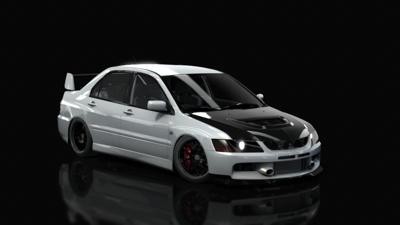
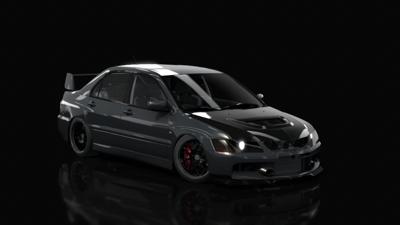
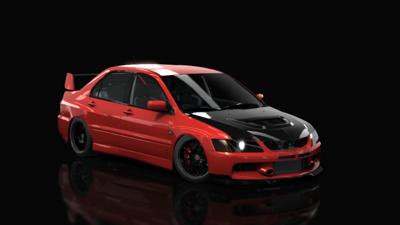
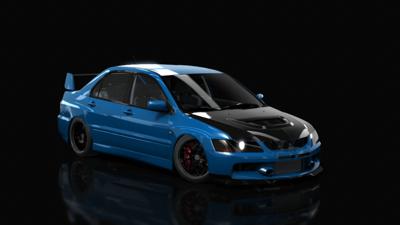
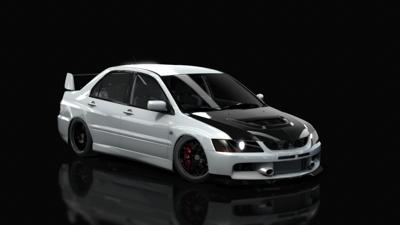
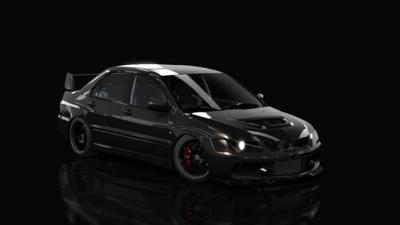
Mitsubishi introduced the Lancer Evolution IX in Japan on March 3, 2005, and exhibited the car at the Geneva Motor Show for the European market the same day. The North American markets saw the model exhibited at the New York International Auto Show the following month. The 2.0 L (1,997 cc) 4G63 Inline-four engine has MIVEC technology (variable valve timing), and a revised turbocharger design boosting official power output at the crankshaft to 291 PS (214 kW; 287 hp) and torque to 392 N⋅m (289 lb⋅ft).
The USDM Lancer Evolution IX models: standard (Grand Sport Rally or "GSR" in some markets), RS (Rally Sport), SE (Special Edition) and MR (Mitsubishi Racing) varied slightly in their performance capabilities. Subtleties unique to each model accounted for variations in acceleration, handling and top speed. The RS excluded features that came standard on the SE and MR models (stereo system, power windows and locks, rear wiper, rear wing, trunk lining and sound insulation). The result is a weight savings of over 60 lb (27 kg). The fuel capacity remains the same as the Evo VIII at 14 U.S. gal (53 L).
Although the RS is the lightest of the group, the RS did not manage to outperform the standard IX and the MR around a road course (even if only by fractions of a second). This was purported to be due to the lack of a rear wing on the RS. In a drag race, the three models are all about even. They are all capable of 0-60 mph (97 km/h) times between 4.2–4.5 seconds, and can run 1⁄4 mile (402 m) times ranging from 12.6 to 13.3 (12.7–13.0 USA versions) seconds depending on the model/driver. The RS model was produced for rally and racing teams who wanted a platform to build a race car from. It is stripped of all the creature comforts, and other upgrades that drive the price up for features that the race teams would not require.
The IX MR retained the features of the Evolution VIII MR, like Bilstein shocks, a 6-speed manual transmission, a rooftop vortex generator, BBS forged wheels, HID xenon headlights, foglights, accessory gauge package, "zero lift" kit, special badging and an aluminum roof. All models continued to sport Recaro bucket seats, Brembo brakes and Momo steering wheels as well. Additional revisions from 2005 included a closer gear ratio for the 5-speed manual transmission, new lighter Enkei wheels on non-MR models, a redesigned front end with a more efficient air dam (the most noticeable feature are the two small oval ducts to cool the intercooler pipes), and a new rear bumper with a diffuser undersurface to smooth out the airflow coming out of the car for non-US models. HID headlights were no longer standard equipment on the base IX (nor were they standard on the 2005 VIII), and were available only in the SSL package (Sun, Sound, and Leather), SE (Special Edition) and MR trims.
The US versions of the Lancer Evolution IX did not come with the AYC but the ACD was still present. The drivers can select from three different driving modes, "Tarmac", "Gravel" and "Snow", and the car's computer system relatively promotes the active center differential to change the differential locking which, despite popular belief, does not change the torque split. The differential is geared at 50:50 and cannot be changed by the push of a button. What this switch actually does is quite simple. Each setting determines how long the ACD will delay in freeing the center differential after a steering input is made. In addition, it will determine how much locking force the ACD will exhibit on the clutch pack and center differential.
Tarmac is the setting to be used in dry, paved conditions. In this setting, the ACD will almost immediately allow the center differential to go into a free state upon detecting a steering input. Additionally, this mode provides the strongest limited-slip clamping force of the three modes. Although the US versions did not come with the AYC, it did come with a rear 1.5way clutch type LSD (limited-slip differential), which limits the slip from both rear wheels causing less traction loss of the rear wheels. The most common setup is the 1.5 way LSD, locking on throttle and partially locking on braking. In racing, Lancer Evolutions are not equipped with AYC or ACD because it is believed that better lap times are achieved by pure driver skill without any computer based assistance systems.
One of the changes from the previous iteration of the Lancer Evolution, was the change in the engine, the new 4G63 came with MIVEC, Mitsubishi's variable valve lifting technology, which drastically improves the fuel consumption by changing the valve timing on the intake cam. The MIVEC system is similar to Honda's i-VTEC system only that it doesn't change valve lift, only intake valve timing.
Three trims were available for Japan, Asia and Europe. Although all models used the same 291 PS (214 kW; 287 hp) engine, the torque differed from one model to another. In Europe, however, the Evolution IX was advertised to have 280 PS (206 kW; 276 hp). The GSR produced 400 N⋅m (295 lb⋅ft) of torque, while the RS and GT produced 407 N⋅m (300 lb⋅ft).


