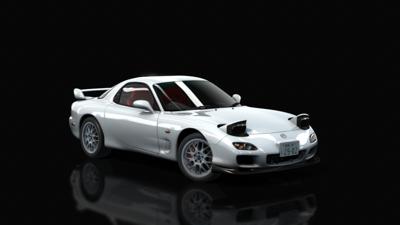
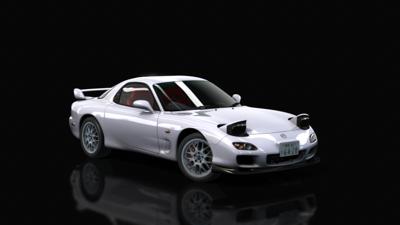
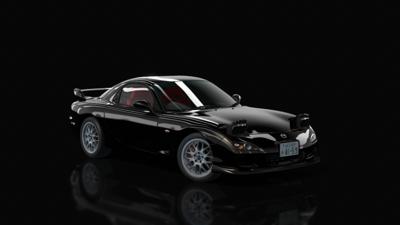
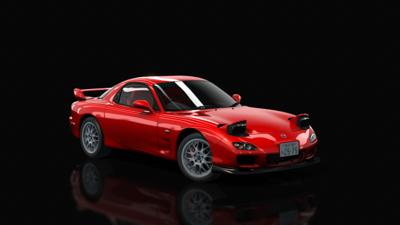
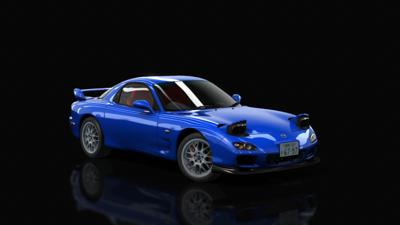
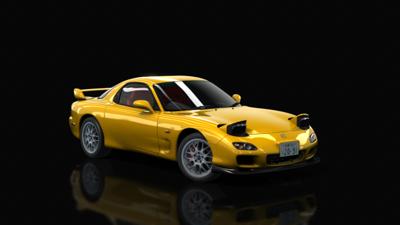
The last commemorative model of the RX-7 that ended its 25-year history.
The FD3S, the 3rd generation RX-7, debuted in December 1991. The name 'Savanna' given to the previous versions was dropped, and it was renamed the ɛ̃fini RX-7.
In order to accommodate wider tyres, the FD3S was significantly widened, but its bonnet, spare wheel, jack, and front and rear double wishbone suspension were all made of aluminium, keeping the vehicle weight down to a miraculous 1,200 kg despite the size increase.
The engine was a 13B Turbo as in the FC3S. However with its new sequential twin-turbo, power output was raised to 251.5 BHP and 30.0 kgfm of torque. The weight-to-power ratio of the lighter Type S reached 4.97 kg/BHP, and the car was the fastest RX-7 ever released, with huge potential.
The FD3S continued to evolve. Body rigidity, the computer, and ABS specifications were upgraded year after year. The Type I, created in 1991, evolved to Type II and III, and finally to the Type VI in 2000.
One of the highlights in this evolution was the limited edition Type RZ, the first Japanese car equipped with 40/45 low-profile tyres. Later in 2001, the Type R Bathurst R was sold with height-adjustable suspension, very unusual for a standard production car.
Of course the engine was improved as well. In 1996, the ECU, intake and exhaust were revised, enhancing power to 261.3 BHP. In 1998, after refining the cooling system and engine, the 276.1 BHP mark was finally reached. The weight-to-power ratio was now 4.56 kg/BHP for the Type R, a performance figure equal to that of supercars.
However, the RX-7 was unable to survive the environmental standards of the 21st century. In August 2002, The RX-7 Spirit R was released as an anniversary model as the last of the series, marking an end to 25 years of production.


