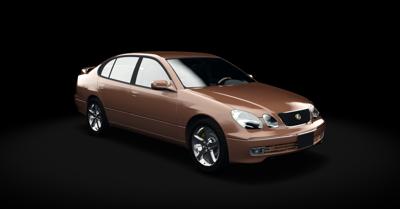
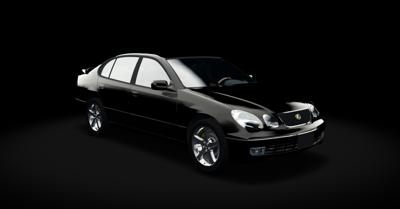
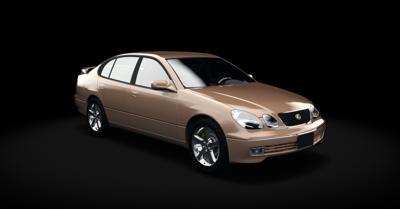
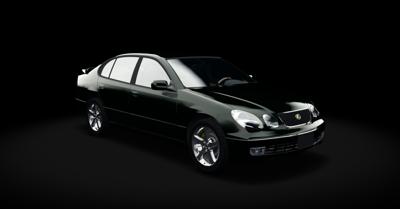
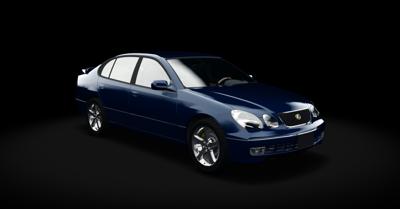
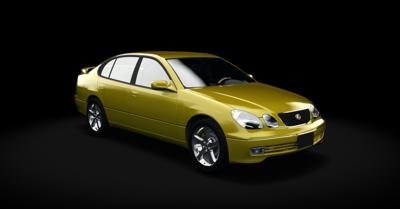
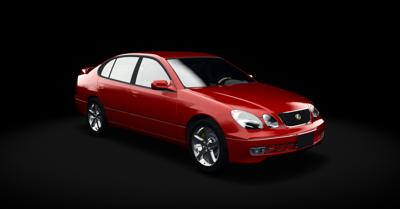
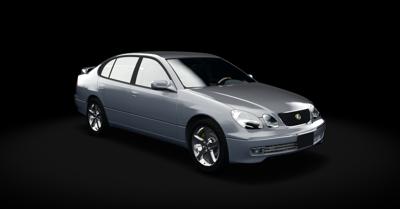
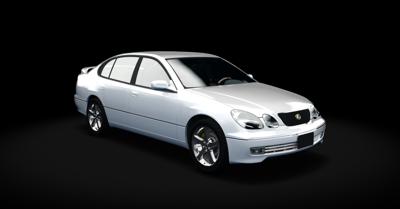
In August 1997, the second generation Toyota Aristo was launched in Japan, codenamed JZS160 (S300 version) for models with 2JZ-GE engines and JZS161 (V300 version) for those with 2JZ-GTE twin-turbocharged engines, remaining exclusive to the former Vista network that was renamed Toyota Netz Store Japanese dealerships. VVT-i was now standard, resulting in an increase of torque. The twin-turbocharged version was available with electronic four-wheel steering, VSC electronic stability control and an automatic transmission with a manual sequential mode.
The second generation sedans used a new front-engine, rear-wheel drive midsize platform, also featured in the Japanese-market Toyota Crown.[15] The new model's styling was produced in-house, and featured quadruple headlights (the interior two of which were elliptical) in a fashion similar to the Lexus SC coupe. It had a drag coefficient of Cd=0.30. Inside, electroluminescent Optitron gauges were offered for the first time, along with an upgraded stereo system. For export markets, the second generation GS began production in the JZS161 body style on 4 August 1997 and was officially launched in October 1997.
Lexus offered the GS 300 once again and featured a slightly revised version of the previous generation's 3.0-liter straight-six now producing 168 kW (225 hp) and 305 N⋅m (225 lb⋅ft) of torque. Answering customer requests for more power, the American market GS 400 (UZS160) was equipped with the 4.0-liter 1UZ-FE V8 that produced 224 kW (300 hp) and 420 N⋅m (310 ft⋅lb) of torque. Both models featured a five-speed automatic transmission with the GS 400 receiving steering wheel shift buttons. As with the S140 series, no turbocharged variants were offered outside Japan. The 0–60 mph (0–97 km/h) time of the GS 400 prompted Lexus to claim that the GS was the world's fastest production sedan at its introduction in 1997.[13] The 1998 BMW M5 sedan would list 0–60 mph (0–97 km/h) times of between 4.8 and 5.2 seconds.[16]


