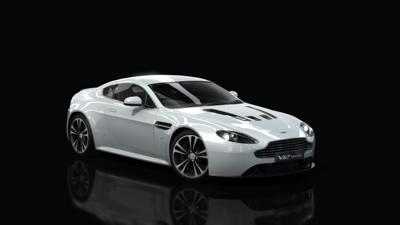
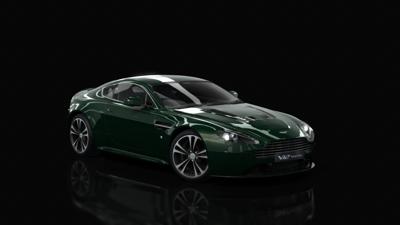
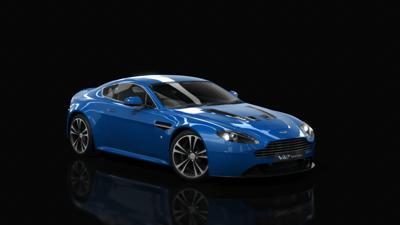
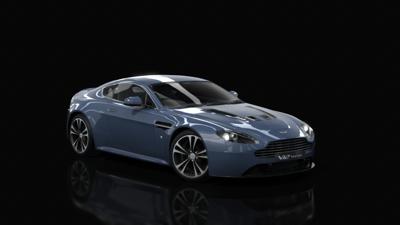
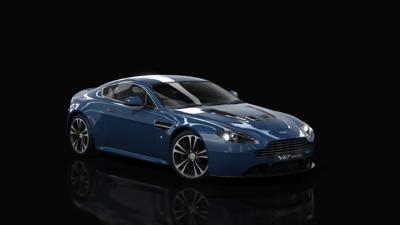
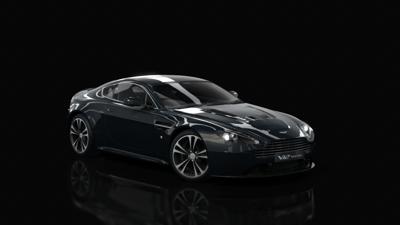
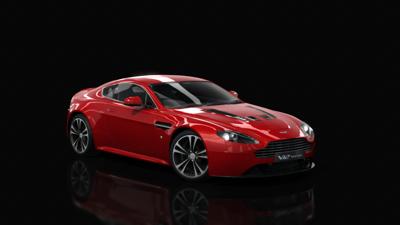
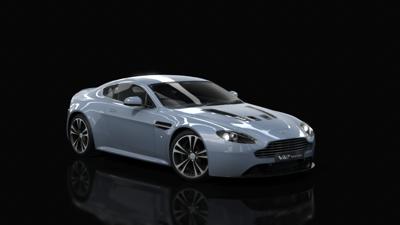
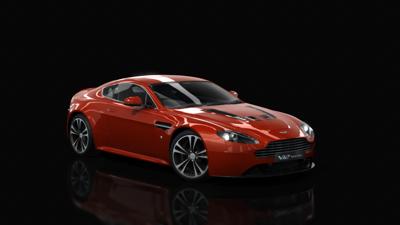
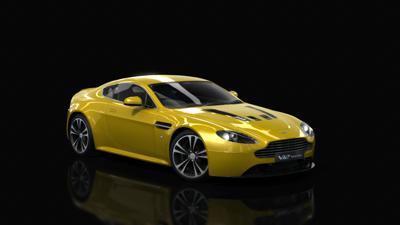
On 11 December 2007, as part of Aston Martin's opening of their own design studio, the company unveiled a concept car based on the V8 Vantage. The car, known as the V12 Vantage RS, featured the AM11 V12 engine from the DBS and produced 510 bhp (380 kW; 517 PS) and 570 N⋅m (420 lb⋅ft) of torque. The power along with the kerb weight of 1,680 kg (3,704 lb) allows the car to accelerate from 0 to 62 mph (100 km/h) in 4.2 seconds and achieve a top speed of 190 mph (306 km/h).
Other additions include a new rear diffuser, a retractable rear-wing which can be raised or lowered, and carbon-ceramic brakes. The boot-lid and vented bonnet are also made from carbon-fibre to help decrease the car's weight. In early 2008, Aston Martin's CEO confirmed production of the V12 Vantage RS for mid-2009.
Development prototypes of the V12 Vantage RS appeared in April 2008 before Aston Martin unveiled the production version, simply called the V12 Vantage, in 2009.
On the finale of the 13th series of Top Gear, presenter Jeremy Clarkson drove the car, opining, "It's wonderful, wonderful, wonderful".
In September 2009, the V12 Vantage was confirmed for the United States market and then-CEO Ulrich Bez personally confirmed that homologation in the United States was underway. This was in response to the decision of expanding the production run beyond 1,000 units.
On 24 August 2011, Aston Martin announced that they were developing a GT3 version of the V12 Vantage, to replace the Aston Martin DBRS9. The race car was expected to be delivered by early 2012.
Aston Martin unveiled a convertible version called the V12 Vantage Roadster which was a limited production of 101 units in 2013. It has a larger rearspoiler and ventilation carbon openings in the bonnet. With a kerb weight of 1,760 kg (3,880 lb) the Roadster weighs 80 kg (176 lb) more due to chassis stiffening modifications, and because of the additional weight the Roadster accelerates from 0 to 62 mph (100 km/h) in 4.5 seconds, but retains the coupé's top speed of 190 mph (306 km/h).
Following the unveiling of the AMV8 Vantage concept car in 2003 at the North American International Auto Show, the production version, known as the V8 Vantage was introduced at the Geneva Motor Show in 2005 for the 2006 model year. The two-seat, two-door coupé had a bonded aluminium structure for strength and lightness. The 172.5 in (4.38 m) long car featured a hatchback-style tailgate for practicality, with a large luggage shelf behind the seats. In addition to the coupé, a convertible, known as the V8 Vantage Roadster, was introduced later in that year.
The V8 Vantage was initially powered by a 4.3-litre (4,280 cc) quad-cam 32-valve V8 which produced 380 bhp (283 kW; 385 PS) at 7,300 rpm and 409 N⋅m (302 lb⋅ft) at 5,000 rpm. However, models produced after 2008 had a 4.7-litre V8 with 420 bhp (313 kW; 426 PS) and 470 N⋅m (347 lb⋅ft) of torque.[11] Though based loosely on Jaguar's AJ-V8 engine architecture, this engine was unique to Aston Martin and featured race-style dry-sump lubrication, which enabled it to be mounted low in the chassis for an improved centre of gravity. The cylinder block and heads, crankshaft, connecting rods, pistons, camshafts, inlet and exhaust manifolds, lubrication system and engine management were all designed in house by Aston Martin and the engine was assembled by hand at the AM facility in Cologne, Germany, which also built the V12 engine for the DB9 and Vanquish.
The engine was front mid-mounted with a rear-mounted transaxle, giving a 49/51 front/rear weight distribution. Slotted Brembo brakes were also standard. The original V8 Vantage could accelerate from 0 to 60 mph (97 km/h) in 4.8 seconds before topping out at 175 mph (282 km/h).
In 2008, Aston Martin introduced an aftermarket dealer approved upgrade package for power and handling of the 4.3-litre variants that maintained the warranty with the company. The power upgrade was called the V8 Vantage Power Upgrade, creating a more potent version of the Aston Martin 4.3-litre V8 engine with an increase in peak power of 20 bhp (15 kW; 20 PS) to 400 bhp (298 kW; 406 PS) while peak torque increased by 10 N⋅m (7 lb⋅ft) to 420 N⋅m (310 lb⋅ft). This consists of the fitting of the following revised components; manifold assembly (painted Crackle Black), valved air box, right and left-hand side vacuum hose assemblies, engine bay fuse box link lead (ECU to fuse box), throttle body to manifold gasket, intake manifold gasket, fuel injector to manifold seal and a manifold badge.
The V8 Vantage had a retail price of £79,000, US$110,000, or €104,000 in 2006, Aston Martin planned to build up to 3,000 per year. Included was a 6-speed manual transmission and leather-upholstery for the seats, dashboard, steering wheel, and shift-knob. A new 6-speed automated manual transmission, similar to those produced by Ferrari and Lamborghini, called Sportshift was introduced later as an option.
In their 2006 readership survey, readers of Car Design News voted the Aston Martin V8 Vantage as the best current production car design. The survey results were based on over 1,000 responses, most from working automotive designers and students of industrial and automotive design. The Vantage was also voted one of Automobile magazine's 2007 "All-Stars" for its performance, road manners, and design. The V8 Vantage is also one of the only two cars to be added to "The DB9 Section", – a mini-fridge reserved for the super "cool" – on the BBC's Top Gear (on which it is described as the baby Aston to differentiate it from the V12 powered DB9). The program rates cars from seriously un-cool to sub-zero. The fridge was an extra category added when the presenters deemed the Aston Martin DB9 too cool for the sub-zero category. In the 2005 awards, Jeremy Clarkson declared the V8 Vantage as Best Sounding Car of the Year and The Coolest Car of the Year, while the award winner was actually the Porsche 911.
While the V8 Vantage was never a common car, the success of the model is highlighted by the completion of chassis number 10,000 – a specially ordered Onyx coupé delivered to a customer in the USA – during the first half of 2008. While the production of 10,000 cars is a tiny number by the standards of typical car manufacturers, it was a significant milestone for an Aston Martin – the DB9 being the only other model to have achieved that number. By the end of production in 2017, Aston Martin had produced 15,417 V8 Coupés, 6,231 V8 Roadsters, 2,551 V12 Coupés, and 465 V12 Roadsters (363 V12 S Roadsters, 101 V12 Roadsters and 1 V12 GT Roadster).[citation needed] While strong demand for the Vantage contributed to Aston Martin's health during this period, it is equally true that the relatively low production of all Aston Martins means seeing a V8 or V12 from this generation remains a rare treat. For perspective, during the same period, Porsche was producing over 20,000 911s annually and have built more than 1 million 911 variants in total.
Design credit for the original V8 Vantage has been disputed. The design is officially credited to Henrik Fisker, design director of Aston Martin at the time the Vantage was introduced. However, some sources, including Callum himself, claim that Ian Callum, director of design for Jaguar at the time and former director of design at Aston Martin, was responsible for creating a large amount of the design for the Vantage during his time at Aston Martin, before Fisker joined the company.[13] In an interview with Car and Driver, when asked how much of the V8 Vantage was completed under his watch, Callum replies "I would say a good 80 percent. In fact, we started the V-8 first and then shelved it while we did the DB9—that’s why they’re quite similar".
In May 2008, Aston Martin announced new technological updates for the Vantage, which included changes to the engine, transmission, suspension and appearance. New cylinder liners that were now pressed into the aluminium block instead of the original cast-in variants allow a thinner liner, which in turn allows a larger capacity of 4.7-litre. The cylinder bore and stroke was increased from 89 mm (3.5 in) to 91 mm (3.6 in) and 86 mm (3.4 in) to 91 mm (3.6 in) respectively, giving a total displacement of 4,735 cc. The dry sump lubrication system was also modified.
The "Sportshift" automated manual transmission benefited from a software update, while a lightened flywheel was introduced for both the manual and the Sportshift versions. Aston Martin also stiffened the suspension and updated them to use Bilstein dampers. An optional sports pack was offered with stiffer springs for better handling and all-new 5-spoke alloy wheels. Sportshift-equipped models also received a new dual throttle mapping update which allows the driver to choose from the default sport mode or comfort mode, meant to provide more comfortable shifts and throttle input for drivability. Combined European fuel economy and CO2 emissions were also improved by 13%. For the 2012 model year, Aston Martin replaced the 6-speed Sportshift with the 7-speed Sportshift II first utilised in the V8 Vantage S.
New wheels were also part of the update including 20-spoke alloy wheels and new 5-spoke aluminium wheels for the sports pack. The interior changed slightly, using an updated console similar to the Aston Martin DBS and the DB9.
The update provided the Vantage with a power increase to 420 bhp (313 kW; 426 PS) at 7,000 rpm (an 11% increase) and a peak torque of 470 N⋅m (347 lb⋅ft) at 5,750 rpm (a 15% increase), providing the car with additional reserves of mid-range performance and an improved top speed of 180 mph (290 km/h). Following the updates, the Vantage is able to accelerate from 0 to 60 mph (97 km/h) in 4.7 seconds.[17] In a road test conducted by Car and Driver, the Vantage accelerated from 0 to 60 mph (97 km/h) in 4.3 seconds and ran the quarter mile in 12.7 seconds at a speed of 180 km/h (112 mph).


