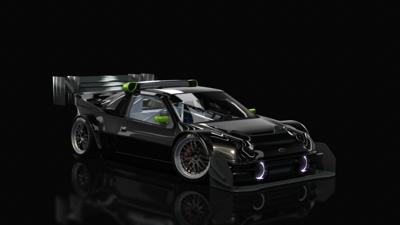
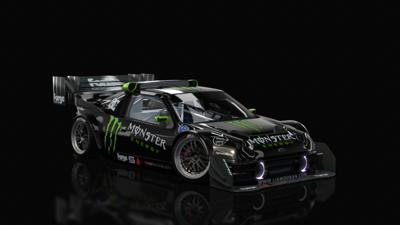
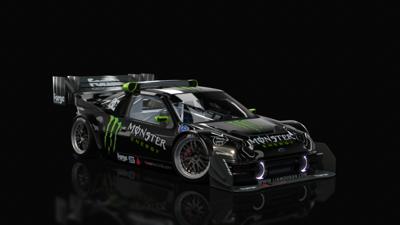
You’ll have no doubt seen
pictures of this car splashed
all over the interweb in the
past few months. It made a
massive impact on the world’s
media when it was unveiled at
Autosport International back
in January, and has been doing the rounds on
various blog sites and forums ever since.
As with so many web phenomena, people
hear half the story and fi ll in the blanks
themselves, so what comes across as ‘internet
fact’ can actually be a poor, speculative, and
often misleading representation of the truth. In
some cases it can be nothing more than simple
hearsay and Chinese whispers.
So, let’s put the record straight. Let’s fi nd out
the whole story. Let’s determine exactly what
this awesome car is, why it was built, and what
its purpose is. And who better to answer these
questions than the man who drives it – one
Liam Doran.
Liam admits the history of the car for the fi rst
10 years or so of its life is a bit sketchy, and
nobody actually knows for certain what it did,
or where it did it. But from 1996 onwards, Liam
and his dad Pat have been aware of this car’s
every move. “It was built by Julian Godfrey in
1996 for Dieter Knüttel who used it for German
hillclimb events,” explains Liam. “We know this
because Julian was actually building ‘Rosie’ (Pat
Doran’s Rallycross RS200) at the same time. The
two cars were built as sister cars, both sharing
many of the same ideas.”
Those ‘ideas’ included the rather genius
touch of doing away with the original
honeycomb structures at the front and rear,
replacing them with spaceframes instead.
This means that the only bit of the original
RS200 chassis left was basically the bit in the
middle that the driver sits on.
Doing so meant that the already
impressive RS200 could be made even
better – much better. “If you look at
where the suspension mounting points
are,” Liam says, pointing at the double
wishbone set-up, “they are all higher up
than on a standard RS200 – this means
the whole car has effectively been
dropped to the fl oor to help improve the
handling.” Standing back and looking at
the level of the sills, you can
see exactly what he means –
this RS200 is lower than any
other we’ve seen, and by
quite a margin too.
This lowering of the
chassis has another
knock-on effect on the
wheel arches, mainly
the fact they can’t
contain the wheels any
longer. That’s why this
RS200 has a custommoulded front bonnet
and rear clamshell
– in carbon fi bre of
course. Just look
at how wide and,
more importantly,
how high the wheel
arches on this car
are. The track has to be
a good 100mm
wider than a
standard RS200,


